
How to Set a Wedding Budget and Stick to It
A practical, no-stress system to plan your dream day—without surprise costs or last-minute panic.
The truth about wedding budgets
A “good” wedding budget isn’t a magic number—it’s a number that fits your priorities, guest count, and venue reality. Most planning guides recommend setting your total budget before you start booking, because once deposits are down, it’s much harder to control the total.
Step 1: Pick your “Total Spend” first (not a Pinterest version)
Start with your maximum total—the number that won’t create regret later.
Add together:
- what you already have saved
- what you can comfortably save between now and the wedding
- any contributions from family (with clear boundaries)
Important: Decide what “comfortable” means. If the budget only works by putting major costs on credit cards, it’s not a plan—it’s stress with confetti.
Step 2: Set your priorities (the 3 things you’ll spend more on)
Before you split dollars into categories, choose your top 3 priorities, like:
- great food + drinks
- photography/video
- an unforgettable party (DJ + lighting)
- a stunning venue
- décor/florals
This aligns with the common advice: focus spending on what matters most to you and avoid chasing every trend.
Step 3: Use a category breakdown as a starting point (then customize)
Most budget guides suggest using a percentage breakdown as a baseline, then shifting money toward what you value.
Here’s a simple, customizable example:
- Venue + food + beverage: largest share
- Photography/video: meaningful investment
- Music/entertainment (DJ/MC) + lighting: protects the vibe
- Attire + beauty: planned and capped
- Florals/decor: flexible depending on priorities
- Stationery + favors + extras: easy to overspend (set limits)
Pro tip: If your venue includes catering, rentals, or staffing, your “venue” line might look bigger—but you may save money overall because fewer vendors are needed.
Step 4: Build “real pricing” with 3 quotes per category
A budget is guesswork until you attach real numbers.
For each major vendor category (venue/catering, photo/video, DJ, rentals/florals), collect 3 quotes and set a realistic mid-point. This step prevents you from building an “imaginary” budget that can’t exist in your market.
Step 5: Don’t forget the hidden costs (the budget killers)
These are common areas couples underestimate:
- service charges, gratuity, taxes
- delivery/setup/teardown fees
- overtime (photo, DJ, venue)
- alterations
- vendor meals
- extra rentals (heaters, tents, generators)
- transportation buffers
Create a line item called “Hidden + Fees” and fund it early.
Step 6: The “Stick to It” rules (simple but powerful)
Want the easiest way to stay on budget? Use rules that prevent impulse upgrades.
Rule A: Every upgrade needs a trade-off
If you add $500 to florals, you subtract $500 from something else. No exceptions.
Rule B: Lock your guest count target early
Guest count changes everything—food, bar, rentals, stationery, favors. Many planning resources emphasize guest count as one of the biggest cost drivers.
Rule C: Track spending weekly
Use a spreadsheet or budget tool and update it once a week. The Knot and Zola both emphasize tracking deposits and payments to keep totals from drifting.
Rule D: Create a “Maybe List”
Write down nice-to-have upgrades (extra lighting, signature cocktails, bigger floral pieces). Only buy them if you’re under budget later.
Step 7: Make your entertainment plan early (it protects your timeline)
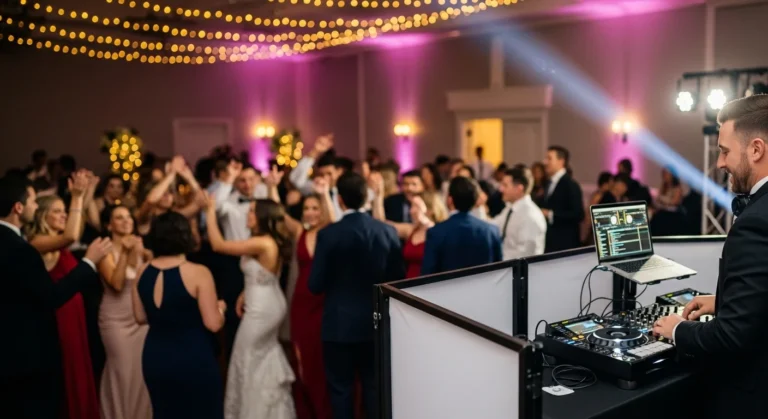
A good DJ/MC does more than play songs—they help the night stay on schedule and keep energy consistent through entrances, toasts, dances, and open dancing. This is one reason wedding budget guides recommend careful vendor selection and clear planning early.

Want a Wedding Reception That Feels Effortless (and Stays on Budget)?
One of the smartest budget moves is booking vendors who help your day run smoothly—so you don’t pay for extra overtime, last-minute add-ons, or “fix it later” solutions.
We provide complete wedding services across St. Louis and Illinois, including DJ & MC entertainment, venue lighting/uplighting, photography, videography, photo booth rentals, and more—so your planning stays streamlined and your reception feels connected.